Imagine having a digital employee who works 24 hours a day, responds instantly to customers, never forgets instructions, follows every process perfectly, and can handle hundreds of conversations simultaneously.
That isn’t science fiction anymore.
It’s the power of Artificial Intelligence Automation.
For years, digital marketers focused on creating more content, publishing more posts, and manually managing customers. Today, successful businesses are taking a different approach. Instead of doing everything manually, they’re building intelligent AI systems that work continuously—even while they sleep.
If you’re looking to automate everything with AI, this guide will teach you how modern businesses use AI-powered chatbots, intelligent agents, automated workflows, and lead generation systems to save time, improve customer experiences, and scale faster than ever before.
Whether you’re a freelancer, agency owner, marketer, entrepreneur, or business owner, automation is no longer an advantage—it’s quickly becoming a necessity.
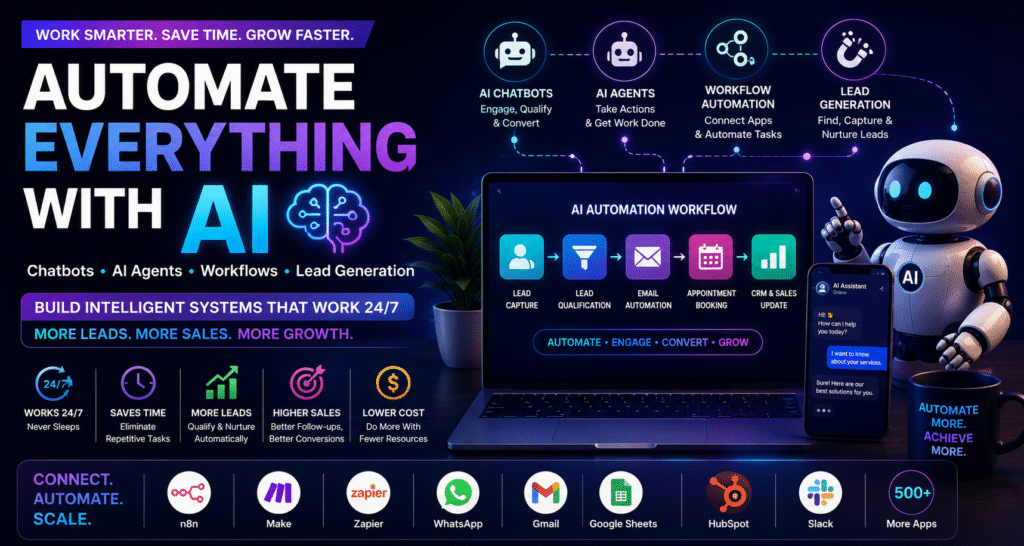
Table of Contents
- What is AI Automation?
- Why AI Automation Matters
- What Can AI Automate?
- AI Chatbots
- AI Agents
- Workflow Automation
- AI-Powered Lead Generation
- AI in Daily Marketing Operations
- Real Business Automation Examples
- Best Practices
- Professional AI Automation Workflow
What is AI Automation?
AI automation is the process of using Artificial Intelligence to perform repetitive business tasks with little or no human intervention.
Instead of manually replying to every message, updating spreadsheets, sending emails, or following up with leads, AI performs these activities automatically.
Unlike traditional automation, AI can understand conversations, make decisions based on context, personalize responses, and complete complex business processes.
Think of AI automation as building a team of intelligent digital assistants that continuously work behind the scenes to support your business.
Why AI Automation Matters
Many marketers spend a large portion of their day performing repetitive tasks that don’t directly contribute to business growth.
Examples include:
- Replying to common customer questions
- Sending follow-up emails
- Scheduling meetings
- Updating CRM records
- Copying data between applications
- Publishing social media posts
- Creating weekly reports
- Tracking leads
Although these tasks are important, they consume valuable time.
AI automation allows marketers to shift their focus toward:
- Marketing Strategy
- Customer Relationships
- Creative Campaigns
- Business Development
- Sales Growth
- Decision Making
Instead of replacing marketers, automation removes repetitive work so humans can focus on high-value activities.
What Can AI Automate?
Artificial Intelligence can automate almost every stage of the digital marketing process.
Marketing Tasks
- Lead Collection
- Lead Qualification
- Email Marketing
- Social Media Scheduling
- Content Distribution
- Campaign Reporting
Sales Tasks
- Proposal Generation
- Quote Creation
- CRM Updates
- Sales Follow-ups
- Appointment Booking
Customer Support
- FAQ Responses
- Order Tracking
- Product Recommendations
- Customer Onboarding
- Ticket Routing
Productivity
- Meeting Summaries
- Task Management
- Document Organization
- Dashboard Creation
The goal isn’t to eliminate human involvement—it’s to eliminate repetitive work.
AI Chatbots
Chatbots are often the first step toward AI automation.
Unlike traditional bots that simply follow fixed rules, AI-powered chatbots understand natural language and respond intelligently to customer questions.
What Can AI Chatbots Do?
- Answer Frequently Asked Questions
- Recommend Products
- Collect Customer Information
- Book Appointments
- Share Pricing
- Generate Quotations
- Capture Leads
- Qualify Prospects
- Transfer Conversations to Human Agents
Where Can Chatbots Be Used?
- Business Websites
- Landing Pages
- Facebook Messenger
- Instagram Direct Messages
- Telegram
- Mobile Applications
- Customer Support Portals
Instead of asking customers to submit a contact form and wait for a response, AI chatbots engage visitors immediately and keep the conversation moving.
AI Agents
Many people think chatbots and AI agents are the same.
They are not.
A chatbot primarily answers questions.
An AI agent completes work.
Chatbot
Can answer:
- Product Information
- Pricing
- FAQs
- Business Hours
AI Agent
Can:
- Schedule Meetings
- Send Emails
- Generate Invoices
- Update CRM
- Assign Tasks
- Generate Reports
- Create Proposals
- Send Follow-ups
- Trigger Automations
AI agents don’t simply communicate—they make decisions and perform actions.
Think of them as digital employees rather than digital receptionists.
Workflow Automation
Every business follows a sequence of actions.
Automation connects these actions into one intelligent workflow.
Example Workflow
Customer visits website
↓
Completes enquiry form
↓
Lead automatically saved in CRM
↓
Welcome email sent
↓
Sales team notified
↓
Meeting scheduled
↓
Reminder sent
↓
Follow-up email delivered
↓
Customer converted
The entire workflow happens automatically without manual intervention.
Popular AI Automation Tools
Different platforms specialize in workflow automation.
| Tool | Best For |
|---|---|
| n8n | Advanced automation |
| Make | Visual workflow building |
| Zapier | Business integrations |
| Pabbly Connect | Budget-friendly automation |
| Microsoft Power Automate | Enterprise workflows |
These platforms connect hundreds of applications together without requiring advanced programming knowledge.
AI-Powered Lead Generation
Lead generation remains one of the most valuable marketing activities.
Artificial Intelligence improves lead generation by identifying the right prospects and automating outreach.
AI Helps You
- Discover Potential Customers
- Build Prospect Lists
- Find Decision Makers
- Personalize Outreach
- Generate Cold Emails
- Write LinkedIn Messages
- Create Follow-up Sequences
- Score Lead Quality
- Prioritize High-Value Prospects
Instead of contacting everyone, AI helps marketers focus on customers most likely to convert.
The Modern AI Lead Generation Funnel
Traffic
↓
Landing Page
↓
AI Chatbot
↓
Lead Qualification
↓
CRM
↓
Automated Email Sequence
↓
Sales Call
↓
Customer
Everything after the first website visit can be intelligently automated.
AI in Daily Marketing Operations
Modern marketers use AI throughout their daily workflow.
Content Marketing
- Generate Blog Outlines
- Repurpose Content
- Build Content Calendars
- Schedule Social Posts
Sales
- Draft Proposals
- Create Quotations
- Follow-up Emails
- Meeting Summaries
Customer Support
- Resolve FAQs
- Route Complex Queries
- Recommend Products
- Track Orders
Reporting
- Weekly Dashboards
- Campaign Performance Reports
- Marketing Insights
- ROI Analysis
Productivity
- Transcribe Meetings
- Summarize Documents
- Organize Projects
- Build Presentations
Automation increases efficiency across every department.
Real Business Automation Examples
Healthcare
AI automates:
- Appointment Booking
- Patient Reminders
- Follow-up Messages
- Prescription Notifications
- FAQ Support
E-commerce
AI automates:
- Product Recommendations
- Cart Abandonment Emails
- Order Tracking
- Customer Support
- Inventory Notifications
Real Estate
AI automates:
- Property Recommendations
- Lead Qualification
- Site Visit Scheduling
- WhatsApp Follow-ups
- Customer Reminders
Education
AI automates:
- Student Enquiries
- Admission Assistance
- Course Recommendations
- Fee Reminders
- Parent Communication
Digital Agencies
AI automates:
- Client Onboarding
- Proposal Generation
- Task Assignment
- Campaign Reports
- Invoice Creation
- Meeting Scheduling
Almost every business can benefit from intelligent automation.
Best Practices for AI Automation
Automation should improve customer experience—not replace human relationships.
Always remember:
- Be transparent when customers interact with AI.
- Allow customers to speak with a human when needed.
- Review workflows regularly.
- Protect customer privacy.
- Keep responses helpful and personalized.
- Test automations before deploying them.
- Continuously improve based on customer feedback.
The best automation feels invisible because it solves problems naturally.
Professional AI Automation Workflow
Modern businesses typically follow this workflow:
Traffic
↓
AI Chatbot
↓
Lead Qualification
↓
CRM Update
↓
Email Automation
↓
Appointment Booking
↓
Sales Notification
↓
Proposal Generation
↓
Follow-up Sequence
↓
Customer
↓
Feedback Collection
↓
Performance Analysis
This structured system allows businesses to scale operations without increasing manual workload.