Creating content is only half the battle. The real challenge is getting that content in front of the right audience, at the right time, on the right platform—and converting attention into leads, customers, and loyal brand advocates.
This is where Artificial Intelligence becomes much more than a content creation tool.
Most people think AI is only useful for writing blogs, generating captions, creating images, or making videos. While AI excels at these tasks, they represent only a small part of its true potential.
The real power of AI lies in its ability to help marketers research audiences, build winning strategies, optimize campaigns, automate repetitive tasks, and make data-driven decisions.
If you’re looking to market anything with AI, this guide will teach you how modern marketers use Artificial Intelligence to grow brands, generate leads, increase sales, and build scalable marketing systems.
Whether you’re managing your own business, working as a freelancer, running a digital agency, or handling marketing for clients, you’ll learn how AI can become your most valuable marketing partner.
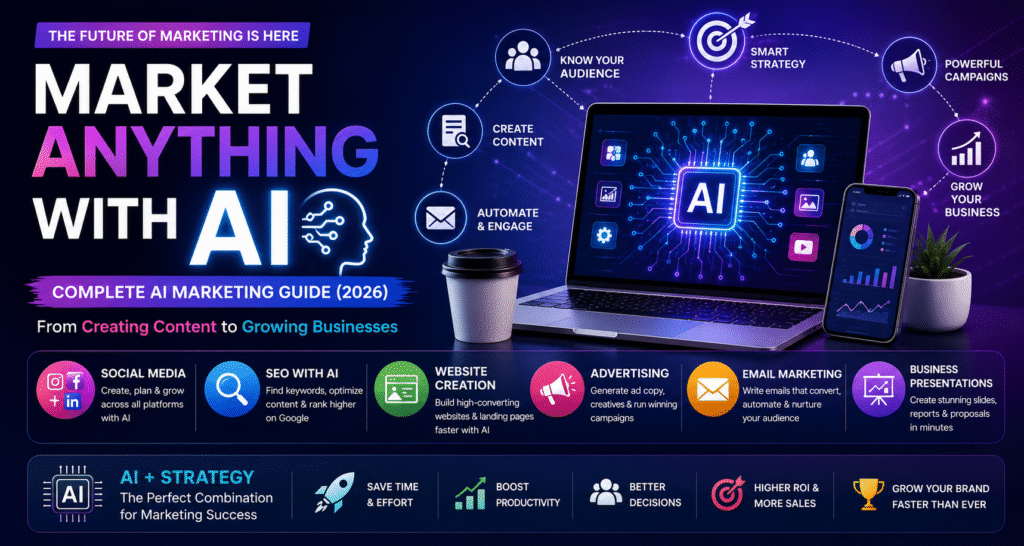
What Does “Market Anything with AI” Mean?
Marketing is much more than creating content.
Successful marketing involves understanding customers, identifying opportunities, solving problems, and delivering the right message through the right channel.
Artificial Intelligence helps marketers perform these activities faster and more efficiently.
Instead of replacing marketing strategy, AI strengthens it by assisting with:
- Audience Research
- Competitor Analysis
- Content Planning
- SEO Optimization
- Website Copywriting
- Advertisement Creation
- Email Campaigns
- Marketing Automation
- Performance Analysis
AI becomes your marketing assistant, while you remain the strategist behind every decision.
Why AI Is Transforming Digital Marketing
Digital marketing has become increasingly competitive.
Consumers expect personalized experiences, businesses demand faster execution, and marketers are responsible for managing multiple channels simultaneously.
AI helps solve these challenges by allowing marketers to:
- Research faster
- Generate ideas quickly
- Create content efficiently
- Personalize campaigns
- Improve productivity
- Reduce repetitive work
- Analyze performance more effectively
The marketers who succeed in the future won’t simply create more content—they’ll create smarter marketing systems powered by AI.
Social Media Marketing with AI
Social media is no longer about posting every day. It’s about publishing content that builds relationships, solves problems, and encourages meaningful engagement.
Instead of asking AI to “write an Instagram caption,” professional marketers use AI throughout the entire content strategy process.
AI Can Help You:
- Research your target audience
- Analyze competitors
- Discover trending topics
- Create content pillars
- Build monthly content calendars
- Write platform-specific captions
- Generate engaging hooks
- Suggest hashtags
- Create powerful calls-to-action
- Repurpose one piece of content into multiple formats
Practical Marketing Questions AI Can Solve
- How do I create a 30-day content calendar in minutes?
- How do I write Instagram Reels that attract views?
- How do I build authority on LinkedIn?
- How do I convert one blog into multiple social media posts?
- How do I analyze competitor content?
Remember:
Posting regularly builds consistency. Strategic content builds businesses.
SEO with AI
Search Engine Optimization has evolved dramatically.
Today, marketers optimize not only for search engines but also for AI-powered search experiences.
Instead of manually researching keywords for hours, AI helps identify:
- High-intent keywords
- User search intent
- Competitor content
- Content gaps
- Topic clusters
- Internal linking opportunities
AI Helps With
- Keyword Research
- Topic Clustering
- Blog Outlines
- SEO Briefs
- Meta Titles
- Meta Descriptions
- Local SEO
- Readability Improvements
- Content Optimization
SEO is no longer about ranking for one keyword—it’s about becoming the best resource for an entire topic.
Website Creation with AI
Your website is more than a digital brochure.
It’s your 24/7 salesperson.
AI helps marketers build websites that are not only visually appealing but also optimized for conversions.
AI Can Assist With
- Website Planning
- Landing Pages
- Service Pages
- Homepage Copy
- Product Descriptions
- FAQs
- User Experience Suggestions
- Chatbot Integration
- Conversion Optimization
Important Questions
- How do I create a landing page that converts?
- How do I improve website copy?
- How do I optimize my website for SEO?
- How do I reduce bounce rates?
Beautiful websites attract visitors.
Optimized websites generate customers.
Advertising with AI
Modern advertising requires far more than writing ad copy.
Successful campaigns are built on:
- Audience Research
- Creative Strategy
- Persuasive Messaging
- Strong Visuals
- Landing Pages
- Continuous Testing
AI accelerates every stage of campaign creation.
AI Can Help You
- Research audiences
- Generate advertising angles
- Write Meta Ads
- Write Google Ads
- Generate creative concepts
- Create multiple ad variations
- Analyze campaign performance
- Suggest optimizations
One of AI’s biggest advantages is the ability to quickly produce multiple creative variations, making A/B testing significantly faster and more effective.
Email Marketing with AI
Despite the growth of social media, email marketing remains one of the highest ROI digital marketing channels.
The challenge isn’t sending emails—it’s writing emails that people actually want to open.
AI helps marketers create:
- Welcome Emails
- Promotional Campaigns
- Product Launch Emails
- Newsletter Content
- Lead Nurturing Sequences
- Customer Retention Campaigns
- Follow-up Emails
- Sales Funnels
Questions AI Can Help Answer
- How do I improve open rates?
- How do I personalize emails?
- How do I automate follow-ups?
- How do I write better subject lines?
AI helps you build relationships—not just email lists.
Business Presentations with AI
Every digital marketer eventually needs to present ideas.
Whether you’re pitching a client, presenting campaign performance, conducting workshops, or proposing a strategy, presentation skills matter.
AI dramatically reduces presentation creation time.
AI Can Help With
- Presentation Outlines
- Marketing Reports
- Client Proposals
- Strategy Decks
- Workshop Slides
- Campaign Summaries
- Professional Design
- Storytelling Structure
Instead of spending hours designing slides, focus on communicating ideas that inspire action.
The AI Marketing Mindset
One of the biggest misconceptions about AI is believing it replaces marketers.
It doesn’t.
AI removes repetitive tasks so marketers can focus on what truly matters:
- Understanding customers
- Solving business problems
- Creating better campaigns
- Making strategic decisions
- Building meaningful brands
The marketers who succeed won’t necessarily use the most AI tools.
They’ll be the ones asking better questions, thinking strategically, and combining AI with human creativity.
Professional AI Marketing Workflow
A modern AI-powered marketing process looks like this:
Research
↓
Audience Analysis
↓
Marketing Strategy
↓
Content Planning
↓
Content Creation
↓
Image Generation
↓
Video Creation
↓
Website Optimization
↓
Advertising
↓
Email Marketing
↓
Automation
↓
Analytics
↓
Optimization
Following a structured workflow ensures AI becomes part of a repeatable marketing system rather than a collection of disconnected tools.
Real-World Example
Imagine you’re launching a new organic skincare brand.
A professional AI marketing workflow might look like this:
- Research competitors using AI.
- Identify customer pain points.
- Build a marketing strategy.
- Create a monthly content calendar.
- Write SEO blog articles.
- Design AI-generated product images.
- Produce Instagram Reels.
- Build a high-converting landing page.
- Launch Meta and Google Ads.
- Create an automated email welcome sequence.
- Monitor performance using analytics.
- Optimize campaigns based on results.
Instead of treating AI as a shortcut, you’re using it to strengthen every stage of your marketing process.
Key Takeaways
- AI is much more than a content creation tool.
- Marketing strategy should always come before content creation.
- AI improves research, planning, execution, and optimization.
- Different AI tools support different marketing activities.
- Automation increases efficiency without sacrificing quality.
- Human creativity and strategic thinking remain irreplaceable.
Internal Linking Suggestions
Connect this article with:
- Prompt Engineering: The Skill That Unlocks the Power of AI
- Understanding AI Models: Which AI Model Should You Use?
- AI Tools Every Digital Marketer Should Master
- Learn Content Creation Using AI
- Learn Creating Professional AI Images
- Learn AI Video Creation Masterclass
- Learn AI Marketing Workflow
- Common AI Content Creation Mistakes We All Make
Outbound Resources
Recommended official resources:
- OpenAI – https://openai.com
- Google Search Central – https://developers.google.com/search
- Google Analytics – https://analytics.google.com
- Meta Blueprint – https://www.facebook.com/business/learn
- Canva AI – https://www.canva.com
Frequently Asked Questions
Can AI replace digital marketers?
No. AI assists with research, content creation, automation, and analysis, but strategy, creativity, and customer understanding remain human responsibilities.
Which marketing channels benefit the most from AI?
Social media, SEO, websites, advertising, email marketing, analytics, and marketing automation all benefit significantly from AI.
Can beginners use AI for marketing?
Yes. AI helps beginners learn faster, generate ideas, and execute campaigns more efficiently while building practical marketing skills.
Does AI improve marketing results?
When used strategically, AI helps marketers improve productivity, personalize campaigns, optimize performance, and make data-driven decisions.
What is the future of AI in marketing?
AI will continue to automate repetitive work, improve personalization, enhance analytics, and help marketers focus more on creativity, strategy, and business growth.