Artificial Intelligence is no longer just another marketing tool—it’s becoming the foundation of modern digital marketing. From researching your target audience to creating content, designing visuals, launching campaigns, automating repetitive tasks, and analyzing performance, AI has transformed how successful marketers work.
However, many beginners make the mistake of using AI randomly. They generate content without planning, switch between tools without a strategy, and expect AI to produce perfect results automatically. Professional marketers follow a completely different approach—they use a structured AI Marketing Workflow.
If you’re looking to learn AI marketing workflow, this guide will teach you how experienced marketers use AI at every stage of the marketing process. Instead of learning isolated AI tools, you’ll discover how to connect them into one seamless workflow that saves time, improves productivity, and delivers better marketing results.
Whether you’re a freelancer, business owner, agency professional, content creator, or student, this framework will help you build an efficient AI-powered marketing system that can be applied to almost any business.
What is an AI Marketing Workflow?
An AI Marketing Workflow is a structured process of using Artificial Intelligence to plan, create, publish, automate, and optimize marketing campaigns.
Instead of relying on one AI tool for everything, professional marketers combine multiple AI platforms to complete different tasks efficiently.
Think of AI as your digital marketing team:
- One tool researches the market.
- Another writes content.
- Another creates visuals.
- Another generates videos.
- Another automates repetitive tasks.
- Another analyzes performance.
When these tools work together, marketing becomes faster, smarter, and more scalable.
Why Every Digital Marketer Needs an AI Workflow
Marketing today involves dozens of tasks every week:
- Market Research
- Competitor Analysis
- SEO
- Blog Writing
- Social Media
- Graphic Design
- Video Editing
- Email Marketing
- Lead Generation
- Analytics
Without a structured workflow, these activities become time-consuming and inconsistent.
An AI workflow helps you:
- Save hours of manual work
- Increase productivity
- Maintain brand consistency
- Create content faster
- Improve decision-making
- Scale campaigns efficiently
- Focus more on strategy than repetitive tasks
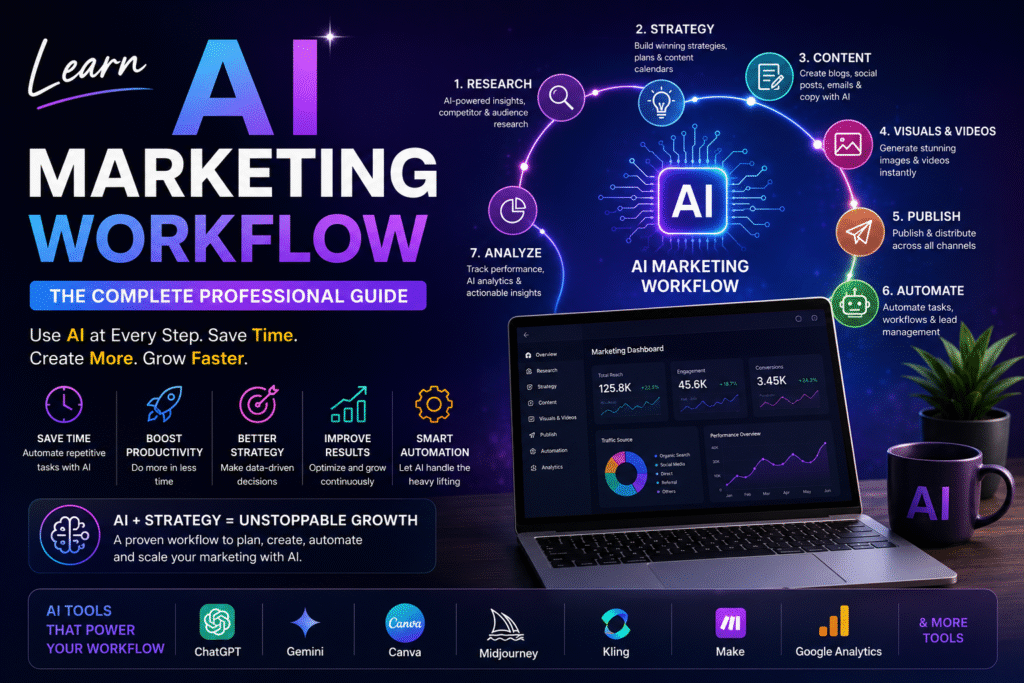
The Complete AI Marketing Workflow
Professional marketers generally follow this sequence:
Research
↓
Planning
↓
Strategy
↓
Content Creation
↓
Image Creation
↓
Video Creation
↓
Publishing
↓
Automation
↓
Analytics
↓
Optimization
Each stage supports the next, creating a repeatable system that delivers consistent results.
Step 1 – Research Using AI
Every successful marketing campaign starts with research.
Before creating content, understand:
- Your target audience
- Competitors
- Industry trends
- Customer pain points
- Keywords
- Market opportunities
Recommended AI Tools
- Perplexity
- ChatGPT
- Gemini
Tasks
- Competitor Research
- Keyword Research
- Customer Reviews Analysis
- Trend Discovery
- Product Research
Research provides the foundation for every marketing decision.
Step 2 – Build Your Marketing Strategy
Once your research is complete, convert your findings into a clear marketing strategy.
Your strategy should answer:
- What are your goals?
- Who is your audience?
- Which platforms will you use?
- What content will you create?
- What action should users take?
AI Helps With
- Marketing Plans
- Campaign Ideas
- Content Calendars
- Audience Personas
- Customer Journey Mapping
A strong strategy ensures every piece of content serves a purpose.
Step 3 – Create Marketing Content
Content is the engine of digital marketing.
AI can generate:
- Blog Articles
- Website Copy
- Landing Pages
- Email Campaigns
- Product Descriptions
- Social Media Captions
- Ad Copy
- Video Scripts
Best AI Writing Tools
- ChatGPT
- Claude
- Gemini
Remember: AI writes drafts. You provide creativity, experience, and brand voice.
Step 4 – Design Images & Videos
Visual content captures attention and increases engagement.
AI Image Tools
- Leonardo AI
- Midjourney
- FLUX
- Ideogram
AI Video Tools
- Kling AI
- Google Veo
- Runway
- Pika
Use AI to create:
- Product Photography
- Advertisements
- Social Media Creatives
- Promotional Videos
- Instagram Reels
- Brand Films
Always maintain consistent colors, typography, and brand identity.
Step 5 – Publish & Distribute Content
Creating great content isn’t enough.
You also need an effective publishing strategy.
Publish across:
- YouTube
- Blogs
- Email Newsletters
Repurpose one piece of content into multiple formats to maximize reach.
Example:
One blog can become:
- Instagram Carousel
- LinkedIn Post
- YouTube Script
- Email Newsletter
- Short Video
- Infographic
This approach saves time while increasing content output.
Step 6 – Automate Your Marketing
Automation allows your marketing to continue working even when you’re offline.
Popular Automation Tools
- n8n
- Make
- Zapier
Automate:
- Lead Collection
- CRM Updates
- Email Sequences
- Appointment Booking
- Social Media Scheduling
- Customer Follow-ups
Automation reduces repetitive work and improves consistency.
Step 7 – Measure & Improve
Every marketing campaign generates valuable data.
Measure:
- Website Traffic
- Engagement
- Click-Through Rate
- Conversions
- Leads
- Sales
- Bounce Rate
- ROI
Analytics Tools
- Google Analytics
- Google Search Console
- Ahrefs
- Semrush
Use AI to identify patterns and improve future campaigns.
Marketing is a cycle of continuous improvement.
Best AI Workflow Tools
| Stage | Recommended Tools |
|---|---|
| Research | Perplexity, Gemini |
| Strategy | ChatGPT, Claude |
| Writing | ChatGPT, Claude |
| Images | Leonardo AI, Midjourney |
| Video | Kling, Veo, Runway |
| Presentations | Canva AI, Gamma |
| Automation | Make, n8n, Zapier |
| Analytics | Google Analytics, Ahrefs |
Choosing the right tool for each stage leads to better results than relying on a single AI platform.
Common AI Marketing Workflow Mistakes
Avoid these beginner mistakes:
- Using one AI tool for every task
- Skipping research
- Publishing AI output without editing
- Ignoring SEO
- No content strategy
- Poor prompt writing
- Inconsistent branding
- Forgetting to analyze performance
The best marketers treat AI as a partner—not a replacement for strategic thinking.
Real-World AI Marketing Workflow Example
Imagine you’re launching a new coffee café.
Workflow:
Research competitors using Perplexity.
↓
Build a marketing strategy with ChatGPT.
↓
Generate a content calendar.
↓
Create social media posts.
↓
Generate café photography with Leonardo AI.
↓
Produce promotional Reels using Kling.
↓
Schedule content using Meta Business Suite.
↓
Automate lead capture with Make.
↓
Analyze campaign performance using Google Analytics.
This integrated workflow saves time while delivering professional-quality marketing.
Key Takeaways
- AI Marketing Workflow is a structured process—not random AI usage.
- Research comes before content creation.
- Strategy drives every marketing decision.
- Different AI tools perform different tasks.
- Automation saves time and improves productivity.
- Analytics helps refine future campaigns.
- Human creativity remains essential for successful marketing.
Internal Linking Suggestions
Connect this article with:
- Prompt Engineering: The Skill That Unlocks the Power of AI
- Understanding AI Models
- AI Tools Every Digital Marketer Should Master
- Learn Content Creation Using AI
- Learn Creating Professional AI Images
- Learn AI Video Creation Masterclass
Outbound Resources
Official learning resources:
- OpenAI – https://openai.com
- Google AI – https://ai.google
- Google Analytics – https://analytics.google.com
- Google Search Central – https://developers.google.com/search
- Canva AI – https://www.canva.com
Frequently Asked Questions
What is an AI marketing workflow?
An AI marketing workflow is a structured process that combines multiple AI tools to research, create, publish, automate, and optimize marketing campaigns.
Why is an AI workflow important?
It improves productivity, reduces manual work, ensures consistency, and helps marketers scale their campaigns efficiently.
Which AI tools should beginners learn first?
Start with ChatGPT for writing, Perplexity for research, Leonardo AI for images, Kling or Veo for videos, and Google Analytics for performance tracking.
Can AI replace digital marketers?
No. AI supports repetitive and creative tasks, but strategy, decision-making, and understanding customer behavior still require human expertise.
How can I build my own AI marketing workflow?
Begin with research, develop a strategy, create content, design visuals, publish across platforms, automate repetitive tasks, and continuously analyze performance to improve future campaigns.